About Bundle
Expert in Intelligence, Counterintelligence and Terrorism Analysis
Start date: Contact us for more information.
Introduction
The program “Expert in Intelligence, Counterintelligence and Terrorism Analysis” It is an advanced training program designed to develop professional skills in the intelligence production, analysis and management, with a focus on complex threats, terrorism and global security. Developed and delivered by A-GLOSS, This itinerary integrates strategic methodologies, HUMINT techniques and tools applied to risk assessment, prevention and detection of threats in dynamic environments.
The student will acquire the ability to interpret operational and strategic information, construct intelligence products, understand radicalization logics and networks, and apply criteria of counterintelligence Focused on information protection, mitigating infiltration, and strengthening institutional security, the training is designed for individuals who require serious preparation for high-impact scenarios, where anticipation and accurate contextual analysis are crucial.
Courses that make up the program
This itinerary is structured in complementary courses that consolidate a comprehensive profile in intelligence and threat analysis:
-
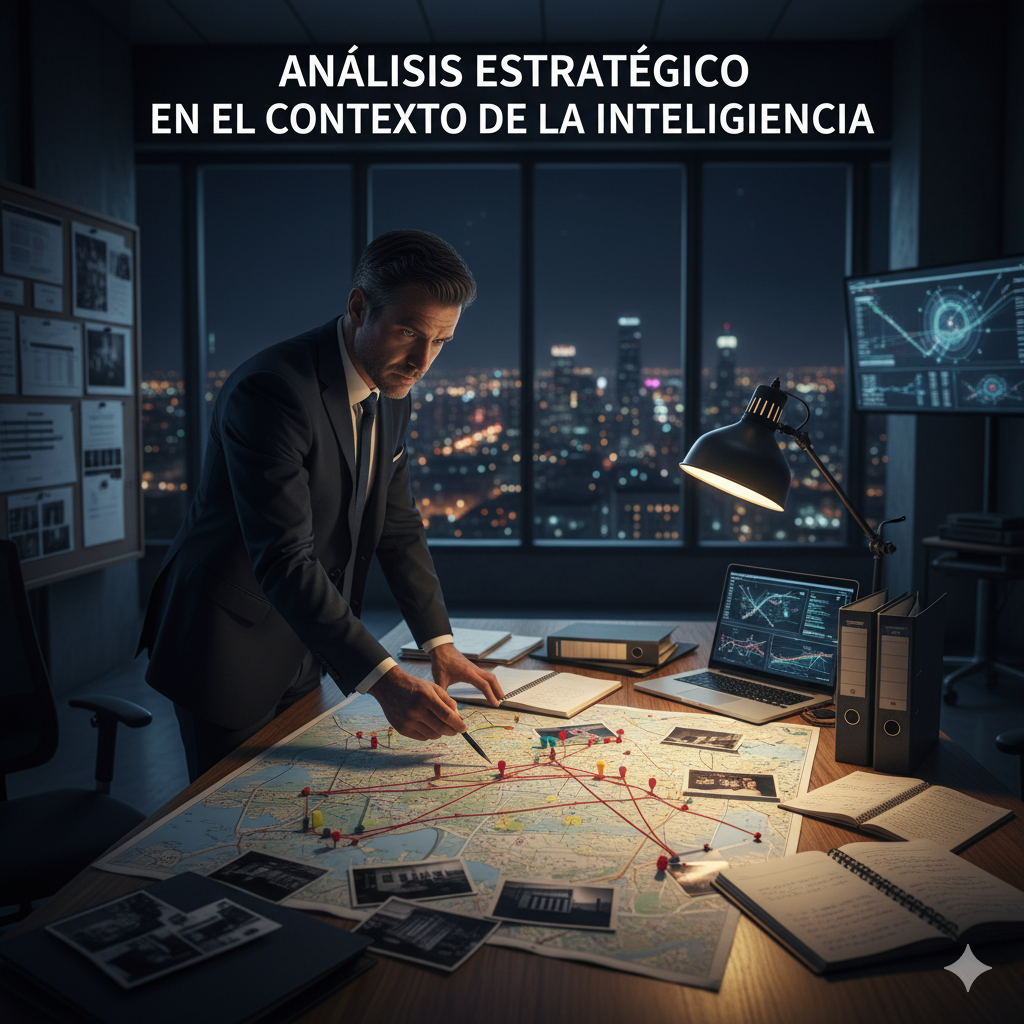
(ANIT) Strategic Analysis in the Context of Intelligence (120 h)
-
(IHUM) HUMINT Intelligence: Information from Human Sources (120 h)
-
(CAGS) Counterterrorism, Information and Global Security (120 h)
-
(IATI) Intelligence Applied to International Terrorism (80 h)
Final integrative project: 100 h
The student will complete an individual project integrating strategic analysis, information gathering and processing techniques, and threat assessment, applying professional intelligence criteria.
Methodology
The program combines theoretical modules with focus practical and applied, incorporating analysis exercises, real cases and methodological construction of intelligence products.
Includes:
-
Training content in web format with educational resources (texts, images, graphics and supplementary material).
-
Supporting documentation and specialized readings (articles, journals, videos, bibliography).
-
Development of exercises focused on the collection, classification, validation, and analysis of information.
-
Application of risk assessment methodologies, scenario analysis and threat analysis.
-
Self-assessments by module for consolidation of concepts and technical criteria.
-
Forums and messaging for interaction with the teacher and resolution of doubts.
-
Individualized tutoring as continuous support for the learning process.
-
Voluntary videoconferences (recorded for later viewing).
-
Final integrative project of realistic application for closing training.
Title
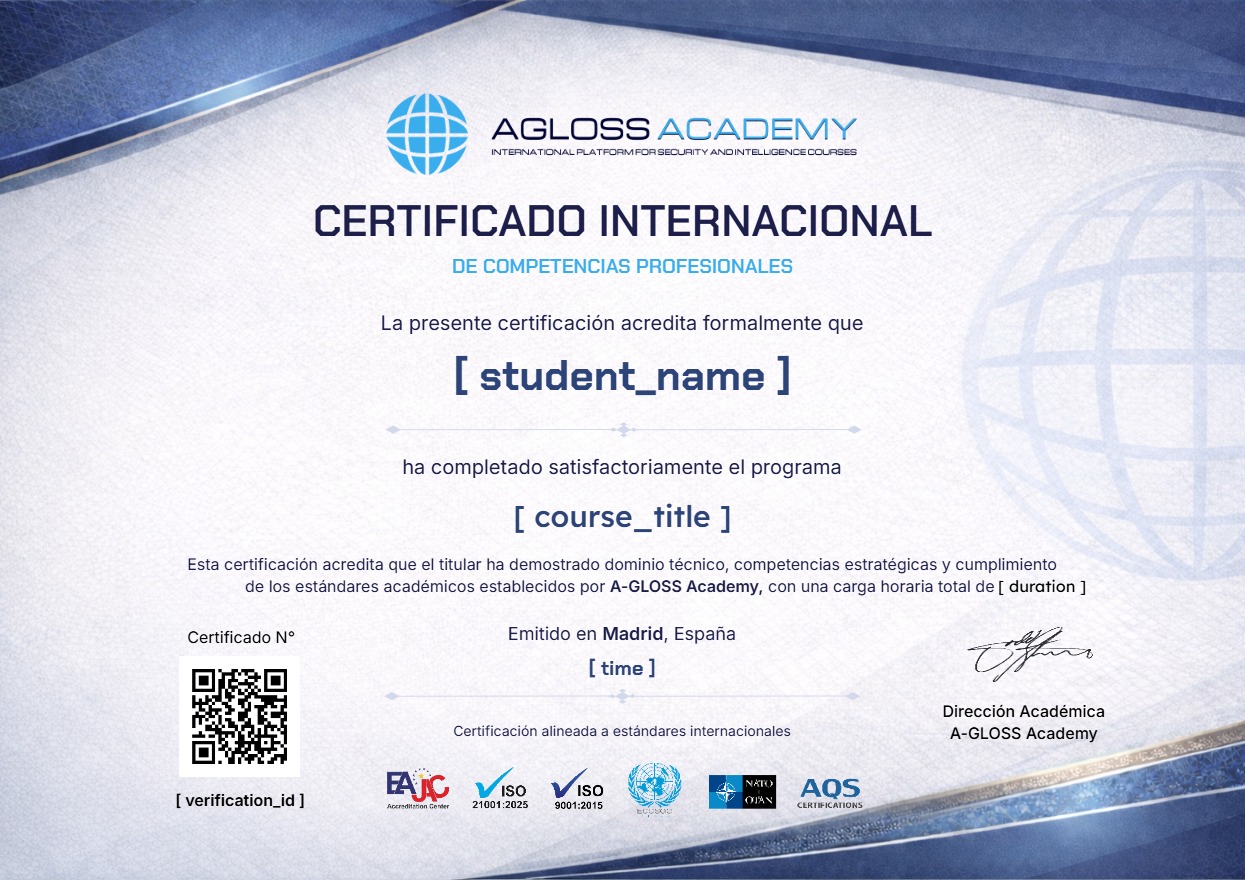
Upon completion, participants will receive a certificate of completion endorsed by A-GLOSS, demonstrating their knowledge and skills as Expert in Intelligence, Counterintelligence and Terrorism Analysis, qualified to perform tasks of analysis, threat assessment, institutional security and strategic information management in critical contexts.
What Will You Learn?
Understanding the intelligence cycle: obtaining, processing, analyzing, producing, and disseminating.
Apply strategic analysis methodologies to interpret complex scenarios and emerging threats.
Design operational and strategic intelligence products using professional criteria.
Identify indicators of radicalization, recruitment, and operational readiness linked to terrorism.
Analyze the structures, capabilities, and modus operandi of terrorist organizations and transnational networks.
Implement HUMINT techniques for obtaining and validating information from human sources.
Evaluate the reliability of sources and information using verification and contrast criteria.
Applying risk, threat, and vulnerability assessment tools in global security.
Integrate situational analysis to anticipate critical events and high-impact scenarios.
Understanding the fundamentals and practices of counterintelligence to prevent infiltration and information leaks.
Design information protection measures, institutional security, and leak control.
Develop counterterrorism analyses focused on the prevention, detection, and mitigation of threats.
Interpret operational information in dynamic and high-pressure environments for decision making.
Develop analytical thinking, critical judgment, and a structured approach to threat research.
Apply professional conduct frameworks, proportionality and legality in intelligence contexts.
Courses in the Bundle (3)

Get your certificate!
Complete the course to obtain the international certificate from A-GLOSS.